

Behind the Scenes of a Distillery: Utilities and Automation at the Distillerie des Cantons

Hello everyone!
On this rainy Sunday, June 9th, I wanted to give you an update on the construction, the assembly of our equipment, and the status of the utilities we need to run the Distillerie des Cantons . Today, we are going under the hood to see exactly where we are at!
Generating Heat: Propane and Electricity
To make whisky, you have to boil your liquid (the wash). Because our system is too demanding to run solely on electricity, we use a hybrid setup:
Propane: Supplied by Superior Propane, this fuels our boiler to create steam, and it also runs the grain drying system in our silos.
Electricity: Thanks to our 600V three-phase connection, we have all the power we need to run our motors and automation systems.
In our mechanical room, the Miura team just finished installing the final pieces of our steam boiler. We expect to be ready for our first steam tests in about two weeks!
Automation: The Brain of the Operation
Another crucial element for automating our processes is compressed air. I am happy to announce that our air compressor has been tested and is fully functional! This air is what will open and close our pneumatic valves automatically.
The true "brain" of the distillery is our main control panel. It houses our Programmable Logic Controller (PLC). Once we develop our perfect whisky recipe, this central computer will ensure we can reproduce it exactly the same way every single time. The miles of wiring from this panel travel through massive cable trays on the ceiling to connect to every piece of equipment in the distillery.
Temperature and Fermentation
To control fermentation temperatures, we have two interacting systems:
A pneumatic valve that controls the flow of glycol (a very cold refrigerant liquid) into the cooling jackets of our seven fermenters.
A thermocouple is inserted into the tank, which sends the real-time temperature back to our control panel.
Managing Waste Ecologically
We finally buried our massive 20,000-liter stillage tank outside. After distillation, the liquid and solid residues will be pumped here. We are currently working on a research program with the National Research Council of Canada to determine how to treat this stillage and spent grain ecologically, so we can reinject it into our own fields as fertilizer.
The Grain Room
We have been using our grain room as temporary storage, but it’s time to clean it up! The team from New Leaf is returning on June 17th to finalize the installation:
The racks for our massive super sacks of grain.
The Roller Mill and Hammer Mill for grinding our barley and rye.
Our massive Grist Hopper, under which we will soon install load cells to accurately weigh every single batch.
The pipes from this room go straight through the wall and directly into our brewing tanks (the Mash Tun and Lauter Tun), where the electrical and pneumatic wiring is nearly complete.
What's Next: Rickhouse, Stills, and Firefighters!
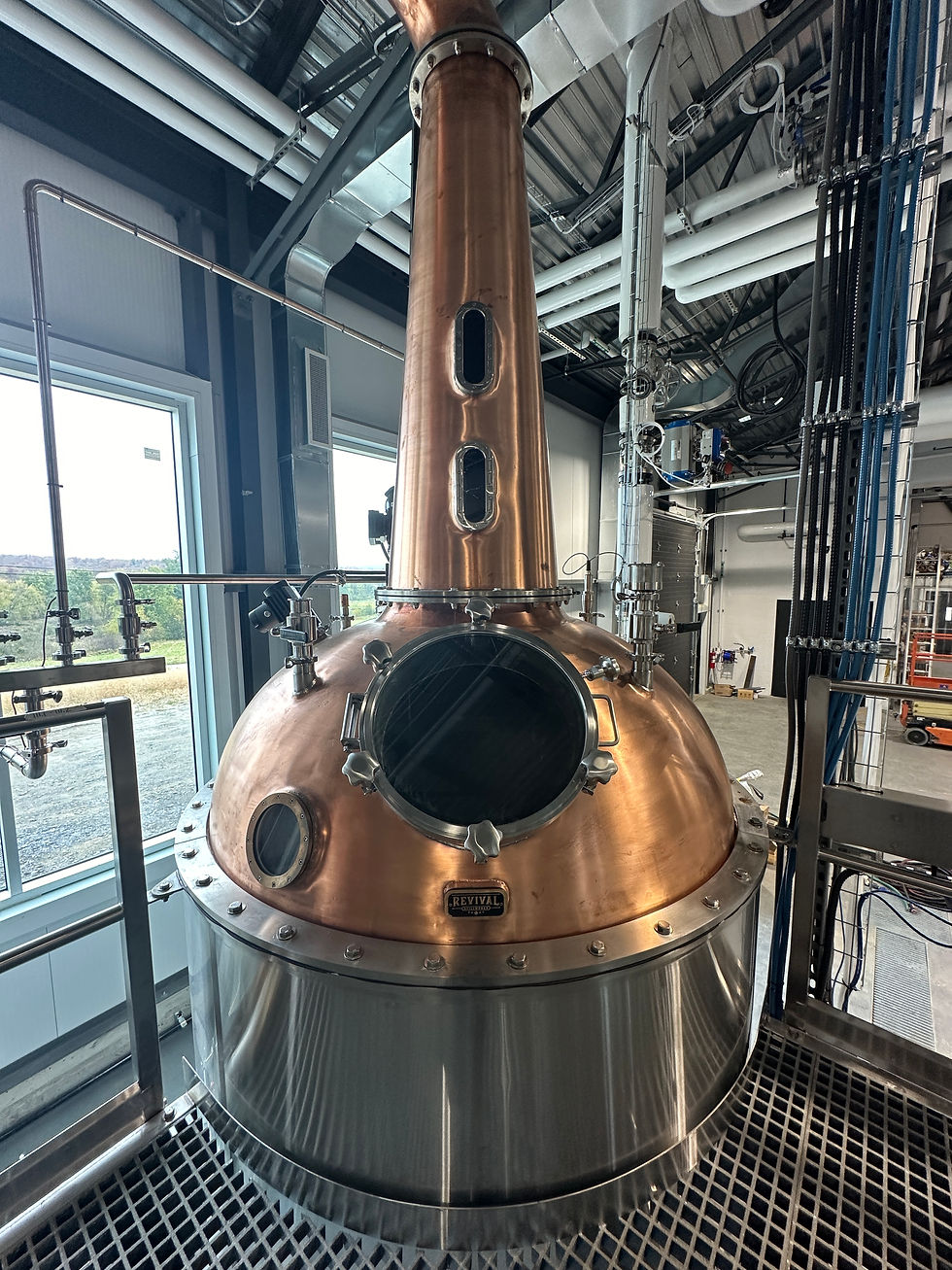
The stills from Revival Stillworks are progressing nicely and are scheduled to ship from British Columbia via truck by the end of July. We are also waiting on a plate heat exchanger and some explosion-proof pumps (for the condensate return) so we can finalize our steam testing before the stills arrive.
Finally, if you look outside the distillery, you will see a large, vacant plot of land. That is where construction of our 10,000-square-foot rickhouse (where we will store our casks) will begin right after the summer construction holiday! Because the water pressure from the town of Mansonville is insufficient for an industrial sprinkler system, we will be building a massive 150,000-gallon water basin underneath this building (the size of an Olympic swimming pool!) powered by a diesel pump. As a bonus, the local firefighters will be able to connect directly to it in case of an emergency anywhere on the property.
See you very soon for the next chapter of this great adventure!
Martin


Comments